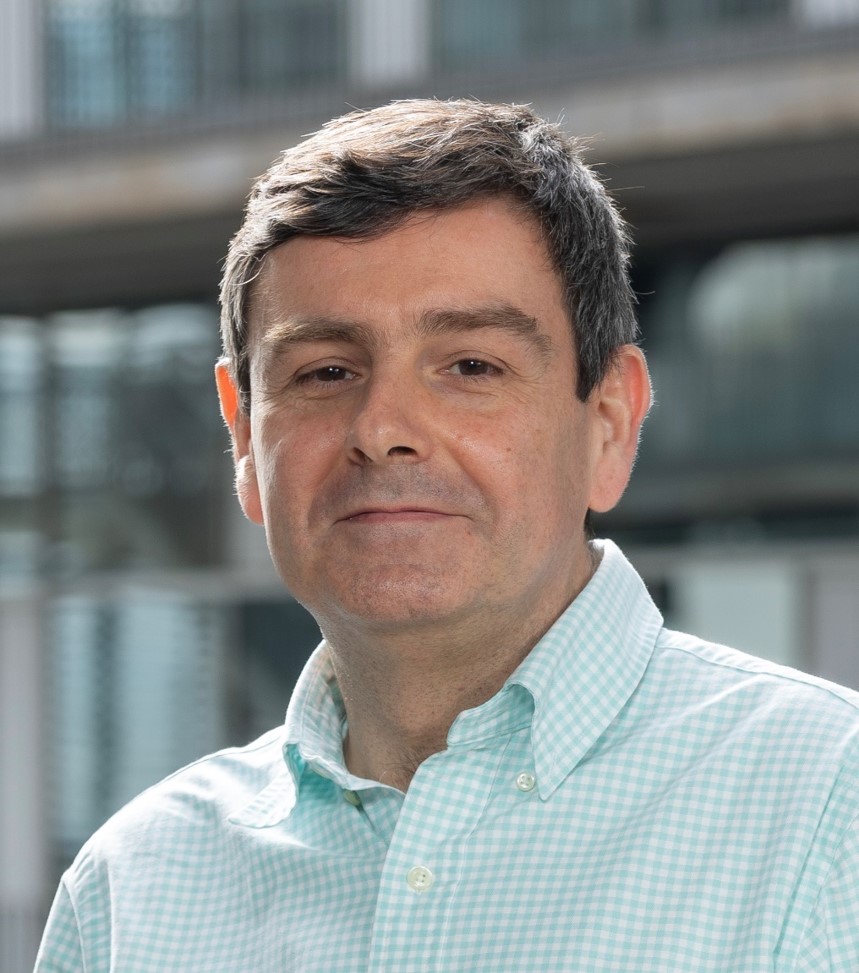
Short bio
Jordi Garcia-Ojalvo obtained his PhD in statistical physics at the University of Barcelona in 1995. He did postdoctoral work at the Georgia Institute of Technology in Atlanta in 1996, working on laser dynamics, and at the Humboldt University of Berlin in 1998 as an Alexander von Humboldt Fellow, studying noise effects in excitable media and neuronal systems. In 2003 he was IGERT Visiting Professor at Cornell University in Ithaca, New York, at which time he began working in the field of systems biology. In 2008 he became Full Professor at the Universitat Politècnica de Catalunya, where he had been teaching applied physics since 1991. He is Visiting Research Associate in Biology at the California Institute of Technology since 2006, and joined the Universitat Pompeu Fabra (UPF) as Full Professor in October 2012, where he leads the laboratory of Dynamical Systems Biology at the Department of Medicine and Life Sciences.
Research interes
The long-term goal of the Garcia-Ojalvo lab is to understand how the behavior of living systems (specifically cells and tissues) emerges from the interactions among their components (genes and proteins within cells, and cells within tissues). To pursue that goal, we use the inherently nonlinear and dynamical character of biological systems, both deterministic and stochastic, as a constraint to identify the operating principles through which living matter self-organizes in space and time. Our work involves a close interplay between experimental observations and theoretical/computational approaches coming from statistical and nonlinear physics. The phenomena that we study include the coordination of dynamical processes in single cells, the origins and effects of randomness and heterogeneity in cellular behavior, and the response of cells and organs (such as the brain) to time-varying environments. The organisms studied range from bacteria to humans. The experimental data used to constrain our models comes from both our lab (in the case of bacteria) and our collaborators.